
She Did Everything Right… So Why Was Her Shoulder Still So Sore?
When Rehab Isn’t Enough: A Case of Shoulder Bursitis
A delightful and incredibly active woman in her 60s came to see me with a long history of shoulder pain that had recently become much worse after a lifting incident.
Because of the sudden increase in symptoms, she was referred for further investigation. Initial ultrasound imaging suggested a tendon tear with bursitis, and an MRI was arranged to get a clearer picture of what was happening.
Imaging Findings
The MRI findings were reassuring in one sense: there was no tendon tear, but bewildering in another - the imaging showed tendinopathy with no tear and bursitis.
I went back to the sonographer and the reader of both the MRI and the Ultrasound, but there was no clear answer. We decided to go with the common denominator - bursitis, and treat the overall clinical picture, rather than the scan.
Planning - System
Both of these conditions can often be managed non-operatively (some peopld call it conservative, but nothing about what I do is conservative) successfully with a well-designed rehabilitation programme.
Treatment with me generally follows the pattern of, manage the:System, Integration, Settle, Deload and Reload.
The programmes are also quite similar in that I assess my clients and treat what I find as the most pressing issue, and because in general, bursitis frequently responds to improving shoulder blade (scapular) mechanics, rotator cuff strength and reducing irritation around the bursa, while tendinopathy best treatment is progressive loading.
With that in mind, we started a personalised rehabilitation programme built around exercises that she felt she could realistically fit into her day.
Rehab Details
Our initial plan was an eight-week rehabilitation programme. This timeframe is commonly used in the research (and is one I've found to be helpful.
When we make the call
If we haven't shifted symptoms significantly (it's probably not fully better in 8 weeks, but we will know if it's going to improve) and gives the shoulder enough opportunity to respond to progressive loading.
From the outset, we also agreed that if things weren't improving, we would reassess and consider other options, including a cortisone injection. The goal was always to choose the pathway that gave her the best chance of getting back to doing the things she loved with the least inputs.
After several weeks of excellent compliance, we reached a point where the shoulder simply wasn't responding the way we would normally expect. I wouldn't expect perfection at this stage, but I would have liked to have seen some changes.
How We Make the Call
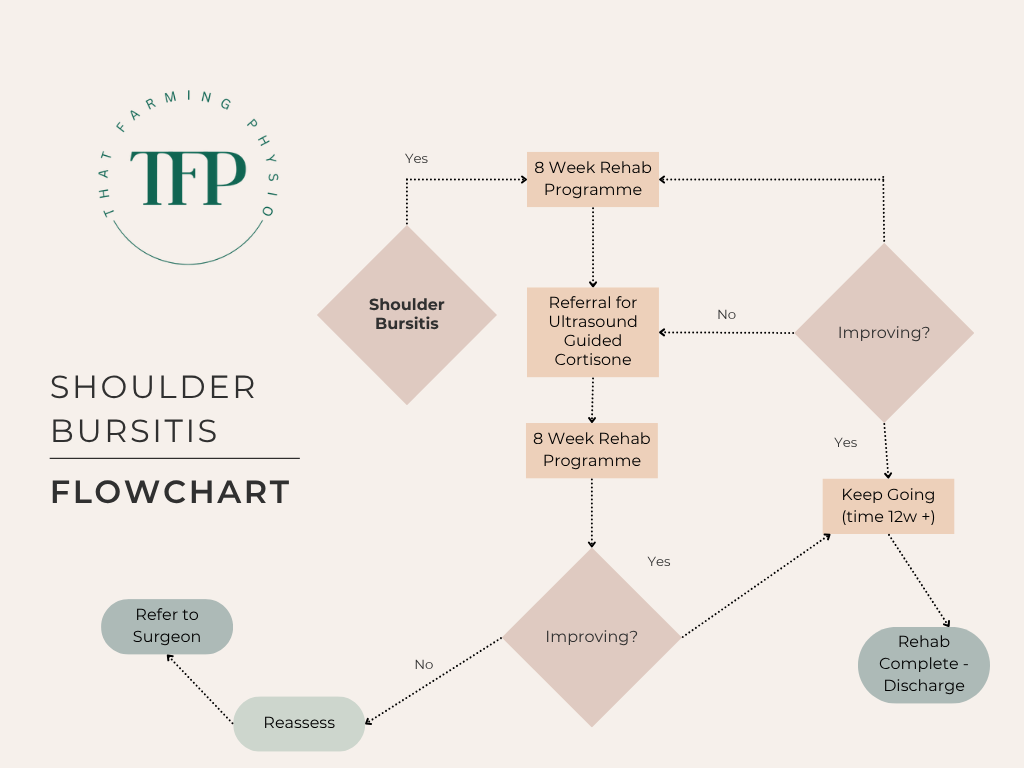
Below is an edited version of the letter I sent following that review appointment.
Dear X,
Thank you for coming in today.
I can see that you've worked hard on your exercises and have been very consistent with your rehabilitation programme. Unfortunately, despite that effort, your pain, strength, range of movement and overall function have remained largely unchanged.
My Clinical Reasoning
If your symptoms were being driven primarily by tendon overload, I would normally expect to see clearer improvement by this stage. Typically we would see:
Reduced pain during and after exercise
Improved tolerance to daily activities
The ability to gradually increase load without flare-ups
That hasn't happened.
A few things stand out:
The exercises have not provided consistent relief
Progress has plateaued despite excellent adherence
Both your ultrasound and MRI identified bursitis
My impression is that the inflamed bursa is acting as a roadblock to rehabilitation. In other words, the exercises themselves are appropriate, but the irritated bursa is preventing us from progressing the programme in the way we need to.
Continuing to push through with rehabilitation alone at this stage risks ongoing pain without meaningful improvement.
Because of this, I believe a cortisone injection is a reasonable option to consider.
Risks and Side Effects
As with any treatment, there are potential side effects and risks.
These include:
A temporary increase in pain for 24–48 hours after the injection
Facial or whole-body flushing
Temporary sleep disturbance or feelings of anxiety
Temporary increases in blood sugar levels
Rare skin colour changes around the injection site
Local fat thinning around the injection site
A very small risk of infection
There is also a temporary weakening effect on tendon tissue following a cortisone injection. This is why load restrictions immediately afterwards are important.
Surgery Considerations
There is generally a three-month stand-down period before surgery can be considered following a cortisone injection.
However, given that your MRI showed no tendon tear, I would not expect surgery to be recommended at this stage.
In addition, following the injection we would complete a structured strengthening programme, and any surgical referral would still require further assessment and funding approval. Because of this, I don't believe the cortisone injection would create any meaningful delay should surgery ever become necessary in the future.
After the Injection
Week One
Do not lift more than 1kg with the affected arm
Avoid lifting above shoulder height
Gentle movement is encouraged
Do not push through pain
Week Two
Increase lifting up to 2kg if comfortable
Continue to stay below shoulder height
Avoid sudden or heavy lifting
After Two Weeks
We will gradually rebuild strength and loading based on your response.
Exercises to Continue
Please continue the following exercises, provided they remain comfortable:
Pendulum exercises, allowing the arm to stay relaxed and floppy
Supported hanging or shoulder decompression positions if they feel relieving
Gentle, comfortable range-of-motion exercises
Pulley exercises
At this stage, avoid progressing any exercise that consistently provokes symptoms.
If an exercise causes a clear flare-up, reduce it or stop it and let me know.
I will see you two weeks after your appointment.
The Bigger Picture
One of the things I love about physiotherapy is that treatment is rarely a straight line.
Sometimes rehabilitation is exactly what's needed.
Sometimes an injection is exactly what's needed.
And sometimes the best outcomes come from combining the two.
I always give my clients information, and the option. Bursitis also rarely happens on it's own, so it's nice to see if we can change it, and the other issues, before we do more BUT it's always dependent on the client, and the situation and what is best for them, in each situation
The important thing is not being emotionally attached to a particular treatment pathway.
The important thing is looking at the response, reassessing when necessary, and choosing the next step based on the evidence in front of us. Once we've looked at everything, including lifestyle, upcoming important dates and more, it's often easy to make a decision. We may delay, because there is a trip coming up and they want to carry their luggage, or they may go earlier, because they want to get it over and done with.
In this case, the exercises weren't wrong. They simply weren't enough to get us past the barrier that the inflamed bursa had created. It is a timing and appropriateness issue, but it's one that can't be determined unless we try first The exact programme that we started with is the one we are going to continue with once the bursa is settled.
If you'd like help working out what's driving your pain and what treatment pathway is most appropriate for you, I'd love to help.
Book an appointment using the link below.
If you have surgery planned, this video can help you to be well prepared with what to expect.
And if you'd like more real-life case studies and practical injury advice, subscribe to the blog so you'll be the first to know when a new article is released.